

Subscribe to newsletter
Thank you! Your submission has been received!
Oops! Something went wrong while submitting the form.
What has changed, what it costs your business, and how to adapt your messaging strategy.
Ihina Das | Product Marketer, Karix
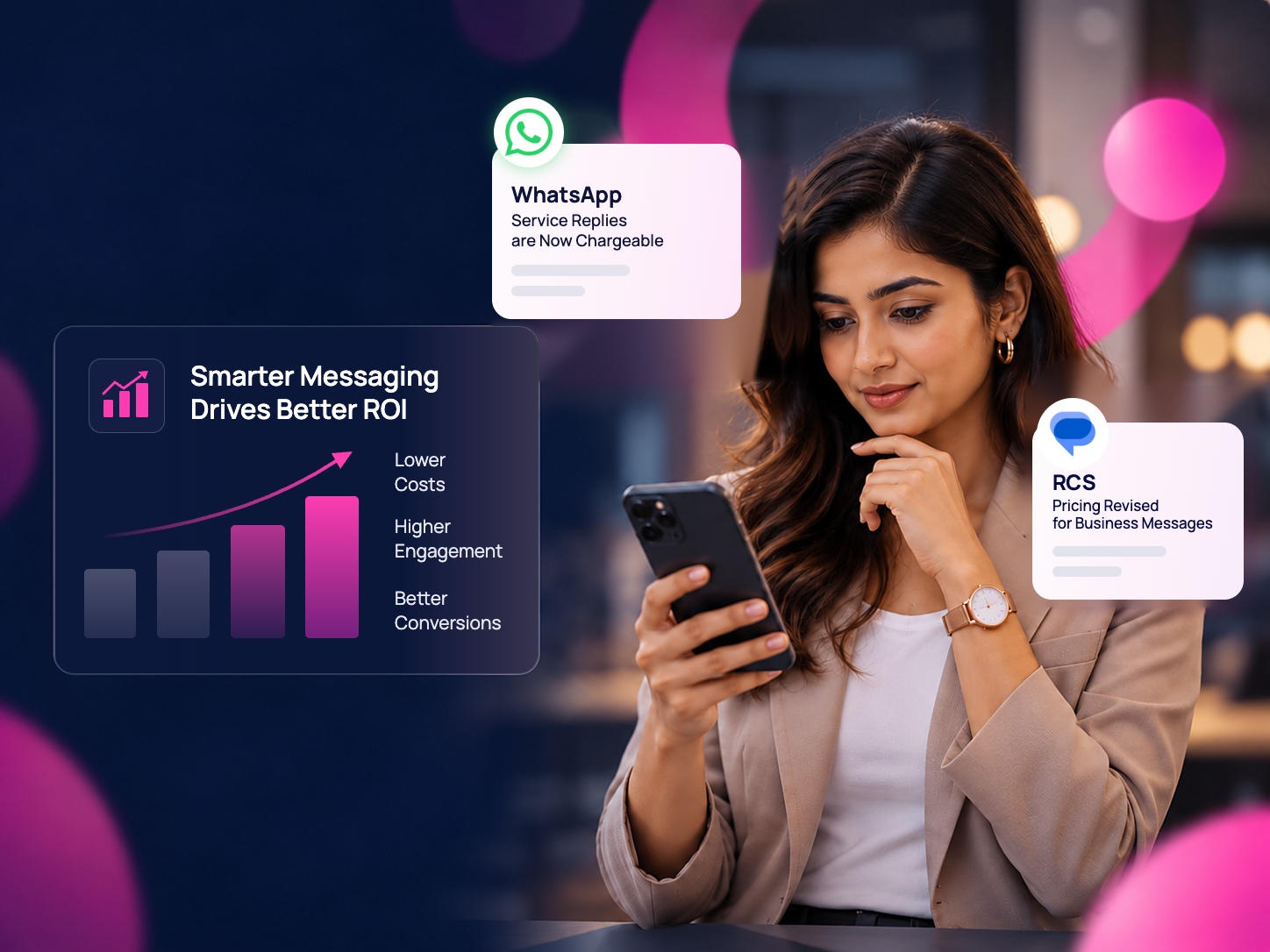
WhatsApp and RCS have revised their pricing in India. For brands, the obvious question is how much more they'll pay. The more useful question is: what are they getting back for what they spend?
Broadcast messaging didn't suddenly become outdated because prices changed. Smart brands moved beyond sending the same message to everyone years ago.
Over a decade ago, marketing technology was already transforming how businesses engaged customers. By 2015, tools for customer analytics, segmentation, marketing automation and behavioural triggers were becoming widely available. Brands could move beyond generic campaigns to respond to customer actions, personalise communication and build journeys around individual preferences.
The rise of Software-as-a-Service (SaaS) accelerated this shift. Capabilities that once required significant technology investments and dedicated IT teams became accessible through cloud-based platforms, bringing sophisticated marketing tools within reach of smaller businesses. AI is now taking this evolution further, making it easier to understand customer intent, personalise interactions and automate conversations at scale.
The rates are changing. The need to make every interaction worthwhile isn't.
Revised RCS rates came into effect for transactional and promotional messages, with promotional messaging costs rising to around 2-3x of previous pricing.
For high-volume senders, the mix of transactional and promotional traffic directly influences messaging expenditure. Brands need to assess that expenditure against campaign performance.
Meta extended the free entry point window for qualifying Click-to-WhatsApp ad conversations from 72 hours to up to seven days, provided businesses respond within 24 hours.
Eligible messages incur no Meta messaging charges during this period. Non-template replies still require an open 24-hour customer service window, while Meta Business Agent token charges continue to apply.
This gives brands more time to follow up with interested customers without additional Meta messaging fees.
Meta began charging for service replies beyond the first 1,000 messages per business number each month. Utility templates sent within an open customer service window are now chargeable from the first message.

Source: Meta's WhatsApp Business Platform pricing
Customer messages remain free.
WhatsApp's pricing model has evolved repeatedly. Meta made service conversations free in 2024, moved to per-message template pricing in 2025, and has now revised the exemptions again.
The lesson is that messaging pricing keeps evolving. Businesses can't treat today's rate card as a permanent fixture.
The cost of inefficient messaging goes beyond the rate per message. A poorly targeted campaign wastes budget on customers unlikely to engage. An unnecessarily long support conversation adds messaging costs and can slow down resolution. As WhatsApp and RCS pricing evolves, these inefficiencies become harder to overlook.
Not every message should be judged by the same measure.
An order update delivers value when it reaches the customer reliably. A support conversation delivers value when the issue is resolved efficiently. A promotional campaign delivers value when it generates meaningful engagement or action.
Rising messaging costs don't mean brands should communicate less.They mean brands need to be more deliberate about where and how they engage customers.
The opportunity is to use each channel where it adds the most value, rather than applying the same messaging approach to every audience and interaction.
The advantage lies in knowing who to reach, what they need, and which channel will get the job done.
Brands cannot simply stop communicating with customers because messaging costs have increased. Campaigns still need to reach audiences, enquiries still need resolving and customer journeys still need supporting.
The answer is to rethink how messaging budgets are allocated across channels and use cases. There are three practical places to start.
Review WhatsApp service volumes, utility templates and conversations requiring repeated replies. For RCS, examine transactional and promotional expenditure against campaign performance.
Identify where broad audience engagement is needed and where a more personalised conversation is likely to deliver greater value.
Businesses running Click-to-WhatsApp ads should make sure they respond to new leads within 24 hours to qualify for the extended free messaging window.
Use customer behaviour and previous campaign results to refine audiences before deciding how to engage them.
RCS can support broader promotional outreach to relevant customer segments, while WhatsApp can be prioritised for high-intent audiences, personalised follow-ups and conversations that require interaction.
WhatsApp Flows, interactive buttons and AI-powered automation canresolve routine enquiries with fewer steps, without compromising the quality ofsupport.
Automation works best when it makes the customer's journey easier.
WhatsApp works well for conversations, support and guided commerce. RCS offers branded, interactive messaging for promotions and notifications, while SMS provides additional reach and fallback options.
Rather than treating channels as interchangeable, brands can use RCS to engage relevant audiences at scale and WhatsApp to continue conversations when customers show interest or need assistance.
The right combination depends on the customer journey, not just the lowest rate on a pricing sheet.
Consider bigbasket. Working with Karix, it introduced RCS alongside WhatsApp for retention and reactivation campaigns. Through experimentation and better channel allocation, it achieved an 80% reduction in messaging costs and 15–20% incremental reach.
Watch the bigbasket success story
These results show what thoughtful channel allocation can achieve.
As a Meta Premier Partner and Google's Top Brand Builder for RCS, Karix helps enterprises build efficient customer journeys across WhatsApp, RCS, and SMS.
From conversational automation and WhatsApp Flows to cross-channel communication and performance analytics, we help businesses make better use of their messaging investments.
Brands can't control every pricing change. But they can control how effectively they engage their customers.
To explore opportunities to optimise your messaging strategy, contact marketing@karix.com.
a Tanla company is a strategic growth partner to enterprises, enabling meaningful, secure, and scalable customer engagements across the most trusted and emerging communication channels. With a future-forward mindset, agile execution, and a 25+ year legacy of innovation, we drive outcomes — not just outputs.